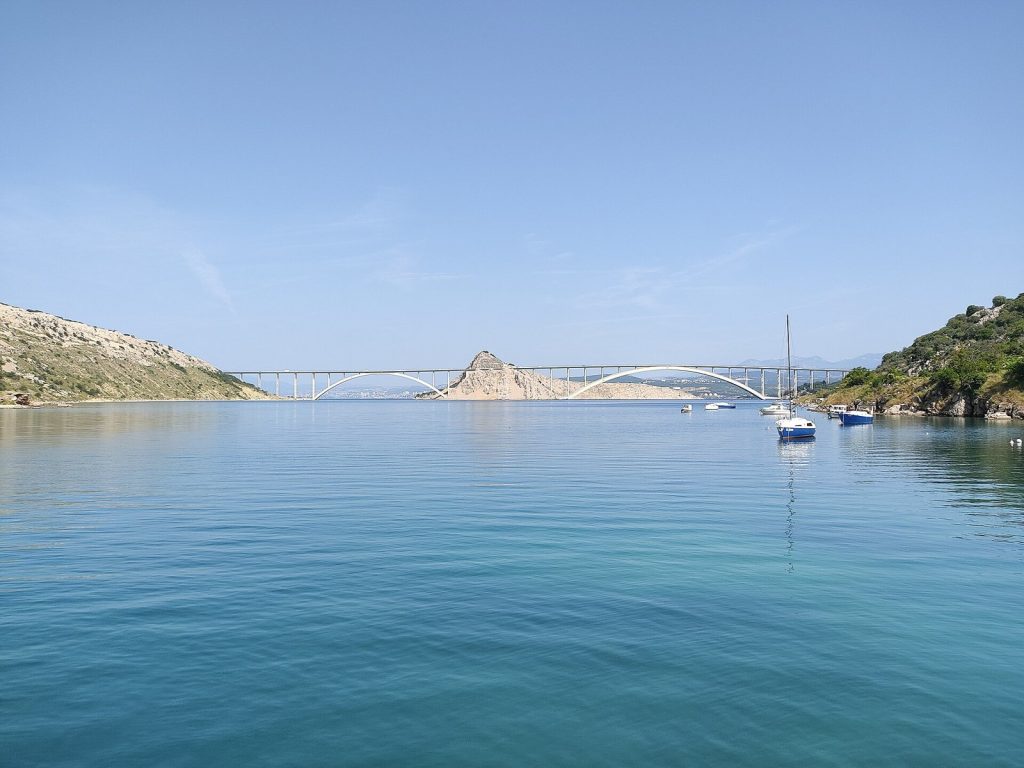
Krk is the Adriatic island you can reach without a ferry, which is why so many drivers treat it as the first Croatian island they ever visit. From Ljubljana the Krk bridge is about 135 kilometres away. In ordinary traffic you can be on the island in a little over two hours, and in the old town of Krk in around two and a half. After that comes a compact network of ordinary roads, a handful of genuine towns, and a southern bay at Baška that still feels like a destination.
At a glance
Ljubljana to the Krk bridge: about 135 km, typically around two hours in free-flowing traffic
Ljubljana to Krk town: about 162 km, typically around two and a half hours
The Krk bridge has been toll-free since 15 June 2020
Slovenia: e-vignette on the motorway; Croatia: the open HAC toll at Rupa, then a toll-free run to the island
Onward ferry from Valbiska to Merag (Cres): short crossing; times and fares on jadrolinija.hr
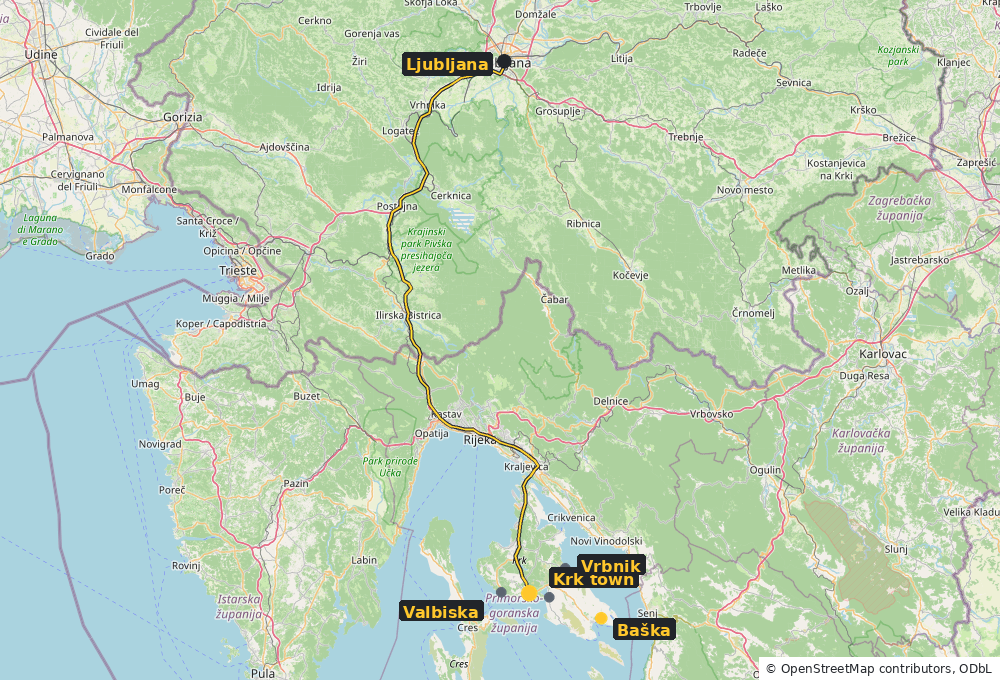
The usual route is simple. Leave Ljubljana on the A1 south, then follow signs for the Rupa crossing into Croatia (via the road towards Ilirska Bistrica and Jelšane). After the border you are on the A7. Pay at the Rupa toll plaza, continue towards Rijeka, and follow the signs for Krk. The Rijeka bypass on this side, and the road out to the bridge, are not a second motorway toll. You cross the bridge and you are on the island. The official Lošinj tourist board gives the same route for drivers from Ljubljana heading onwards to Cres. Use it unless you have a reason to go the long way around through Istria.
In summer, Friday afternoons heading south, and the Sunday return, can add time on the A1 and on the last stretch towards the bridge. The border itself is no longer a systematic passport queue, but build in a margin anyway.
Once you are over the bridge you are on ordinary island roads. The first settlements are Omišalj, on the north shore, and then a choice. West takes you towards Njivice and Malinska, a gentler, more resort-like coast. South takes you towards the town of Krk, about 27 km and half an hour from the bridge. The roads are generally good, but they are not wide, and in July and August they carry a lot of traffic. Leave more time than the map suggests, especially for the last kilometres into Baška, which twist down to the bay. The bora can make exposed sections unpleasant, and it is the usual reason the bridge is restricted. Fuel is available in the main towns, and there is no extra toll once you are across.
Tolls and vignette
The Krk bridge has been free to cross since 15 June 2020 — a decision of the Croatian government, published in the official gazette (NN 61/2020) and confirmed at the time by the transport ministry. Drive across, keep to the signed speed, and remember that the bridge can be closed or restricted in a strong bora. If the wind is up, check hak.hr before you set out.
What you do still pay:
Slovenia. An e-vignette, bought before you join the A1, from evinjeta.dars.si. For a typical passenger car (class 2A) the official prices on 24 November 2026 were €16 weekly, €32 monthly and €117.50 annually. The weekly vignette covers seven consecutive days from the start date you choose. Check the class of your vehicle if you are in a taller van.
Croatia. The open toll at Rupa, just after the crossing. Official HAC Category I rate on 24 November 2026 was €1.10, including VAT, in either direction. Pay by card, cash or ENC. There is no Croatian vignette. As of late 2026 you still stop at the plaza; a new free-flow system, Crolibertas, is scheduled to apply fully from 1 March 2027. After Rupa, the Rijeka bypass towards the island is toll-free, and so is the bridge. For a straightforward Ljubljana–Krk run, Rupa is the only Croatian motorway charge you should expect.
The border. Croatia has been in the Schengen area since 1 January 2023. Slovenia lifted temporary internal controls on this border at midnight on 11 June 2026. Carry a passport or EU identity card, because random checks can take place. Children need their own document. Croatia has used the euro since 2023.
Ferry
If Krk is only the first island, the car ferry from Valbiska, on the south-west of Krk, runs to Merag on Cres. The port is about 29 km from the bridge, typically a little over half an hour. The crossing is a short, frequent Jadrolinija service (line 332); the official 2026 timetable gives 25 minutes. Times and fares change with the season, and some early or late sailings do not run on certain winter Sundays and holidays. You cannot reserve a specific departure on this line: Jadrolinija’s official FAQ classifies it among the routes that issue tickets without a reserved sailing. A ticket is valid for any crossing on the date printed on it, and vehicles board in the order they reach the port. Check the current timetable and the price for your vehicle on jadrolinija.hr. In high summer, arrive at the terminal with time to spare — Jadrolinija advises one to two hours, and earlier in the tourist season; a place on the sailing you hope to catch is not guaranteed. From Merag you can be in Cres town in about twenty minutes, or down at Osor and on to Lošinj in well under two hours of driving, plus any wait at the crossing.
Where to park
There is no single island-wide parking operator, and tariffs change by municipality and by season, so this guide does not invent a price list. The working rule is the same in Krk town, Punat, Vrbnik and Baška: use the official signed car parks, expect to pay in the warmer months, and do not drive into the oldest streets in the hope of a free space. In Baška in summer, arrive earlier than you think you need to. Overnight guests should ask their host where to leave the car.
What to see
Krk town, Punat and the west coast
Krk town is the place to start: a walled old town, a cathedral complex, and a working harbour. Park in a signed public car park outside the tightest streets and walk in. The old town is compact; an hour or two on foot is enough for a first visit.
From Krk town, Punat is only about 8 km, a short drive around the bay to one of the island’s best-known marinas. The reason to come, besides the waterfront, is the islet of Košljun and its Franciscan monastery. You do not drive there; you take a short boat from Punat, and should check the current times locally. The west and north-west coast — Malinska, Njivice, and the coves between them — is the easier swimming country, and a good first afternoon if you do not want to go straight to the southern end of the island.
Vrbnik and Baška
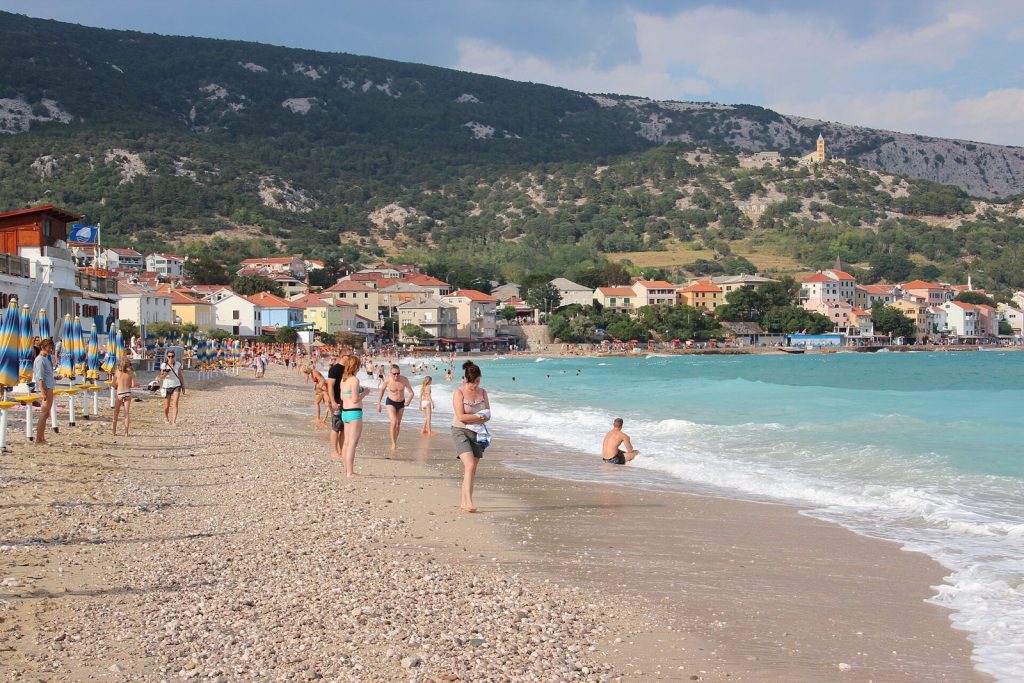
The bay and pebble beach at Baška, on the south-east of Krk. Photo: Andorado / Wikimedia Commons, CC BY-SA 3.0
Vrbnik sits on a cliff on the east coast, about 11 km from Krk town, and is the village most visitors associate with the island’s žlahtina wine. Parking is at the edge of the village, not in the lanes. Go for the walk, the lookout, and a glass of wine if that is why you came.
Baška, at the south-eastern end of the island, is the other essential stop, and the one that takes the most driving. From the bridge it is about 45 km and typically a little under an hour; from Krk town it is about 19 km. The bay is the point: a long pebble beach, a promenade, and a town that in summer is very much awake. Just inland, at Jurandvor, the church of St Lucy holds the Baška tablet, one of the most important early Croatian inscriptions; confirm opening times on the spot. Stara Baška, over the ridge, is a smaller, more rugged cove on a narrower road — beautiful, but not the place to meet oncoming buses at speed. Inland, Dobrinj is quieter, and the Biserujka cave is a modest organised visit if you want something that is not a beach or a church. Opening hours are seasonal; check before you detour.
Suggested day plan
Drive: about 135 km to the Krk bridge (typically around two hours) and about 162 km to Krk town (around two and a half hours) in free-flowing traffic.
Start in Krk town: a walled old town, a cathedral complex and a working harbour. An hour or two on foot is enough for a first visit.
Punat is only about 8 km further, for the marina and the short boat to Košljun (check the current times locally).
Vrbnik sits about 11 km from Krk town, on the east-coast cliff. Baška, at the south-eastern end, is about 19 km from Krk town or about 45 km from the bridge, typically a little under an hour from the bridge.
If Krk is only the first island, continue from Valbiska to Cres and Lošinj.
Practical tips
Coming home, the drive from Krk town to Ljubljana is the same 160-odd kilometres in reverse. Leave earlier on a summer Sunday than you would like, make sure your e-vignette still covers the return, and remember that the €1.10 at Rupa is due again on the way out.
No. The Krk bridge has been free to cross since 15 June 2020 — a decision of the Croatian government, published in the official gazette (NN 61/2020). The bridge can be closed or restricted in a strong bora; if the wind is up, check hak.hr before you set out.
What do I still pay?
A Slovenian e-vignette on the A1, and the open HAC toll at Rupa (€1.10 for a Category I car on 24 November 2026, in either direction). After Rupa, the Rijeka bypass towards the island is toll-free, and so is the bridge. For a straightforward Ljubljana–Krk run, Rupa is the only Croatian motorway charge you should expect.
Can I reserve the ferry from Valbiska to Merag?
You cannot reserve a specific departure on this line. Jadrolinija’s official FAQ classifies it among the routes that issue tickets without a reserved sailing. A ticket is valid for any crossing on the date printed on it, and vehicles board in the order they reach the port. In high summer, arrive one to two hours ahead; a place on the sailing you hope to catch is not guaranteed.
What does parking cost on Krk?
This guide does not invent a price list: there is no single island-wide operator, and tariffs change by municipality and by season. Use the official signed car parks, expect to pay in the warmer months, and do not drive into the oldest streets in the hope of a free space.