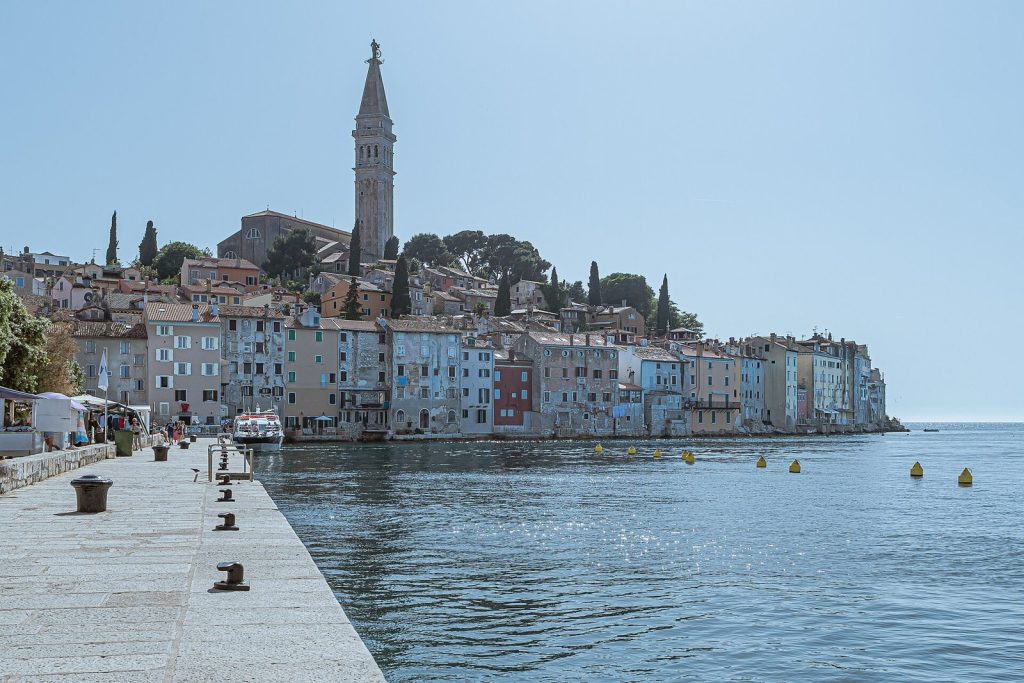
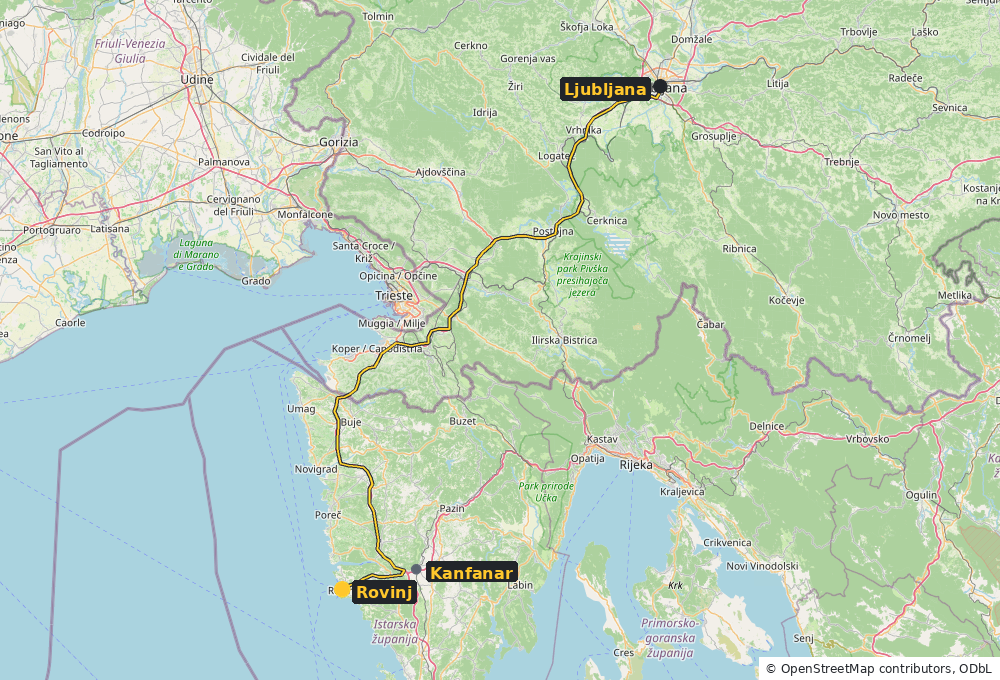
Rovinj is a little under 190 kilometres from Ljubljana — close enough for a long weekend, and far enough that the drive already feels like a holiday. In ordinary traffic you can be looking at the harbour from the hill of St Euphemia in about two and a half hours. This guide covers the two main routes from the Slovenian capital, what you pay, how the border works now that Croatia is in the Schengen area, and where to leave the car. The old town sits on a tight peninsula: park outside it and walk.
At a glance
Distance: about 187 km to the centre of Rovinj
Driving time: typically around 2 hours 20 minutes in free-flowing traffic; allow longer on summer Fridays and Sundays
Slovenia: electronic vignette before you join the motorway
Croatia: distance-based tolls (the Istrian Y is run by Bina Istra, not HAC)
Border: no systematic passport checks; still carry a passport or EU identity card
Both routes are motorway almost to the last stretch, and both end on the same local road from the Kanfanar interchange into Rovinj, about 18 km through Putini — the arrival the official Rovinj tourist board describes.
Via Koper and Umag (the west-coast route). This is the more direct run. Leave Ljubljana on the A1 towards Koper, stay on the motorway past Postojna and the Črni Kal viaduct, then follow signs for the coast and the Škofije crossing. Trieste sits just west of this corridor if you are combining the trip with a stop in Italy. In Croatia you join the A9, the western arm of Istria’s motorway “Y”, and stay on it to the Kanfanar exit.
From 1 January 2026 you no longer need a Slovenian e-vignette for the coastal expressway between the Škofije border and Izola (the former H5 and H6, now reclassified as main roads). DARS has described the change as temporary, until the new Koper–Dragonja expressway is finished. The speed limit on that stretch is 90 km/h. You still need a valid e-vignette for the A1 from Ljubljana down to the coast.
Via Rupa, Rijeka and the Učka tunnel. Use this if you are already heading towards Kvarner, or if you want to continue later to Krk or to the Brestova ferry for Cres. Take the A1 south, then the road towards the Rupa crossing. In Croatia you pay the open toll at Rupa, continue towards Rijeka and pick up the A8 through the Učka tunnel. A second tube opened in September 2024, so the old single-tube queues are much less common. Exit at Kanfanar and follow the same local road into town. The route takes a little longer, and you pay two Croatian operators instead of one.
Tolls and vignette
Slovenia. Vehicles up to 3.5 tonnes must have a valid e-vignette before they enter a motorway or expressway. Buy it from the official shop at evinjeta.dars.si, where it is tied to your number plate. You can set the start date for the day of purchase or up to 30 days ahead. For a typical passenger car (class 2A: up to 3.5 t, height above the front axle not more than 1.30 m) the official prices on 24 November 2026 are €16 weekly, €32 monthly and €117.50 annually. The weekly vignette covers seven consecutive days from the start date you choose, ending at midnight on the seventh day; it is not a rolling 168 hours. Taller vans often fall into class 2B — check your vehicle on the same site before you pay.
Croatia. Croatia does not use a vignette. You pay per section at toll plazas, in cash, by card or with an ENC electronic tag. As of late 2026 the plazas still use tickets and barriers. A new free-flow system, Crolibertas, is scheduled to apply fully from 1 March 2027; until then, take a ticket if you do not have ENC, and pay at the exit.
The motorways in Istria — the A8 and A9, which meet at Kanfanar — are operated by Bina Istra, on a separate price list from HAC. Official Category I rates (a standard car with two axles, height up to 1.90 m), including VAT, from Bina Istra’s calculator on 24 November 2026, were €4.70 from Umag to Kanfanar, €8.70 from the Učka tunnel to Kanfanar, and €10.50 from the tunnel to Pula. On the Rupa route you also pay the HAC open toll at Rupa, €1.10 for a Category I car on the official tariff the same day. Confirm current amounts on bina-istra.com and hac.hr.
The border. Croatia has been in the Schengen area since 1 January 2023 (land and sea borders from that date; air borders from 26 March 2023). There are no systematic passport checks between Slovenia and Croatia. Slovenia lifted temporary internal controls on this border at midnight on 11 June 2026, but police can still carry out random checks, so keep a passport or EU identity card to hand. Children need their own document. Visa-free visitors from outside the EU are recorded in the Entry/Exit System at their first Schengen entry. Croatia has used the euro since 2023.
Ferry
For Cres or Lošinj you will need a Jadrolinija ferry from Brestova or, via Krk, from Valbiska; check sailings and fares on jadrolinija.hr.
Do not plan to drive into the old town and look for a space at the door. The historic peninsula is a dense mesh of marble streets: use a municipal car park and walk. In high summer the closest parks are a short walk; the cheaper outlying ones are further out.
All city paid parking in Rovinj is managed by Komunalni servis. The closest official barrier-controlled parks are Velika Valdibora and Mala Valdibora, beside the harbour and the market; they fill early on summer mornings. Boksiti is a solid alternative a little further out. The tourist board also lists Nova Hladnjača (Hladnjača 2), Fra Pavla Pellizzera and the Grand Park Hotel garage.
If you are staying the day, or overnight without hotel parking, the open Zone 4 parks are usually better value. Official names in that zone include Monvi, Škaraba, Porton Biondi and Centener-Cuvi. On the tourist board price list checked on 24 November 2026, Zone 4 was €1 per hour or €7 per day from 1 April to 31 October (charged 06:00–23:00). In the same summer period, Velika and Mala Valdibora and Boksiti were €3.50 per hour, around the clock. Rates are seasonal; confirm them at rovinj-tourism.com or at the machines.
Payment in the closed parks is at the terminal; in the open parks you can pay at a meter, at the Valdibora cashier’s office, by QR code, or with the Bmove and Aircash apps. SMS payment is listed for Croatian mobile numbers only.
What to see
Rovinj old town and the Golden Cape
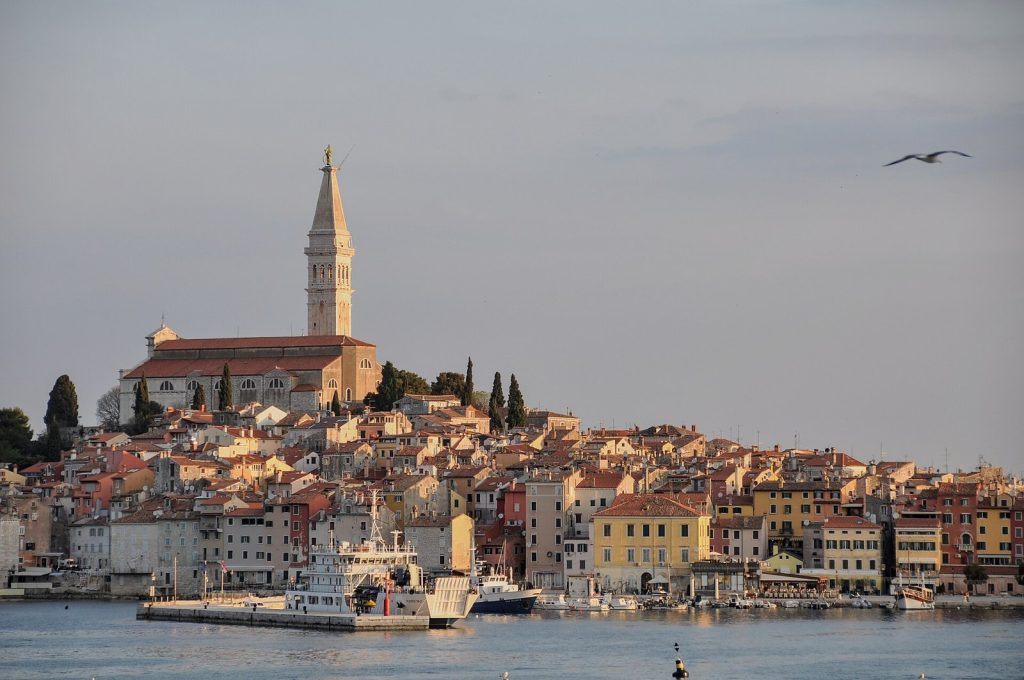
The old town of Rovinj from the south, early morning. Photo: Ironbernietyrol / Wikimedia Commons, CC BY-SA 4.0
Once you have parked, walk. The old town is the point of coming: the climb to the church of St Euphemia, the tight streets that drop to the harbour, the evening light on the waterfront. The Batana house, on the harbour, is a small museum devoted to the town’s flat-bottomed fishing boat. South of the centre, the Golden Cape (Zlatni Rt / Punta Corrente) forest park is the place for a swim and a walk under pines; it has a large car park of its own if you drive there separately. The Lim Channel, a few kilometres north, is an easy half-day detour.
Suggested day plan
Drive: about 187 km, typically around 2 hours 20 minutes in free-flowing traffic; allow longer on summer Fridays and Sundays.
Park at Velika or Mala Valdibora, Boksiti, or a Zone 4 park (Monvi, Škaraba, Porton Biondi, Centener-Cuvi) and walk into the old town.
Afternoon on foot: the church of St Euphemia, the harbour and the Batana house; a swim at the Golden Cape (Zlatni Rt) if you still have the energy.
Optional half-day: the Lim Channel, a few kilometres north. Pula is about 35 km further south.
If you have three or four days, continue on the Istria loop.
Practical tips
On the west-coast drive, keep any break short: a coffee after the Črni Kal viaduct, a detour to Piran on the Slovenian coast, or a longer pause in Novigrad or Poreč only if you are not in a hurry. On the Učka route you can peel off into the inland hill towns, though that is really the start of a longer Istria loop. Buy the e-vignette before you join the A1, and in Croatia do not lose the toll ticket if you have no ENC tag. Summer Fridays heading south, and Sundays heading back, are the slow periods. Fuel is often a little cheaper in Slovenia, and headlights are required there during the day. If you continue to Pula, about 35 km further south, leave the car outside the historic core and walk to the Arena.
Yes, before you join the A1. For a typical passenger car (class 2A) the official prices on 24 November 2026 were €16 weekly, €32 monthly and €117.50 annually, from evinjeta.dars.si. From 1 January 2026 you no longer need a vignette for the coastal stretch between Škofije and Izola; the speed limit there is 90 km/h. You still need one for the A1 from Ljubljana.
Does Croatia use a vignette?
No. You pay per section at toll plazas, in cash, by card or with an ENC tag. The Istrian A8 and A9 are run by Bina Istra, on a separate price list from HAC. Official Category I rates on 24 November 2026 included €4.70 from Umag to Kanfanar. A free-flow system, Crolibertas, is scheduled to apply fully from 1 March 2027; until then, take a ticket if you do not have ENC.
Are there passport checks at the border?
Croatia has been in Schengen since 1 January 2023. There are no systematic passport checks between Slovenia and Croatia. Slovenia lifted temporary internal controls at midnight on 11 June 2026, but police can still carry out random checks, so keep a passport or EU identity card to hand.
Can I drive into the old town?
Do not plan to. Use a municipal car park and walk. The closest official barrier-controlled parks are Velika Valdibora and Mala Valdibora; Boksiti is a solid alternative. Zone 4 parks are usually better value for a longer stay.