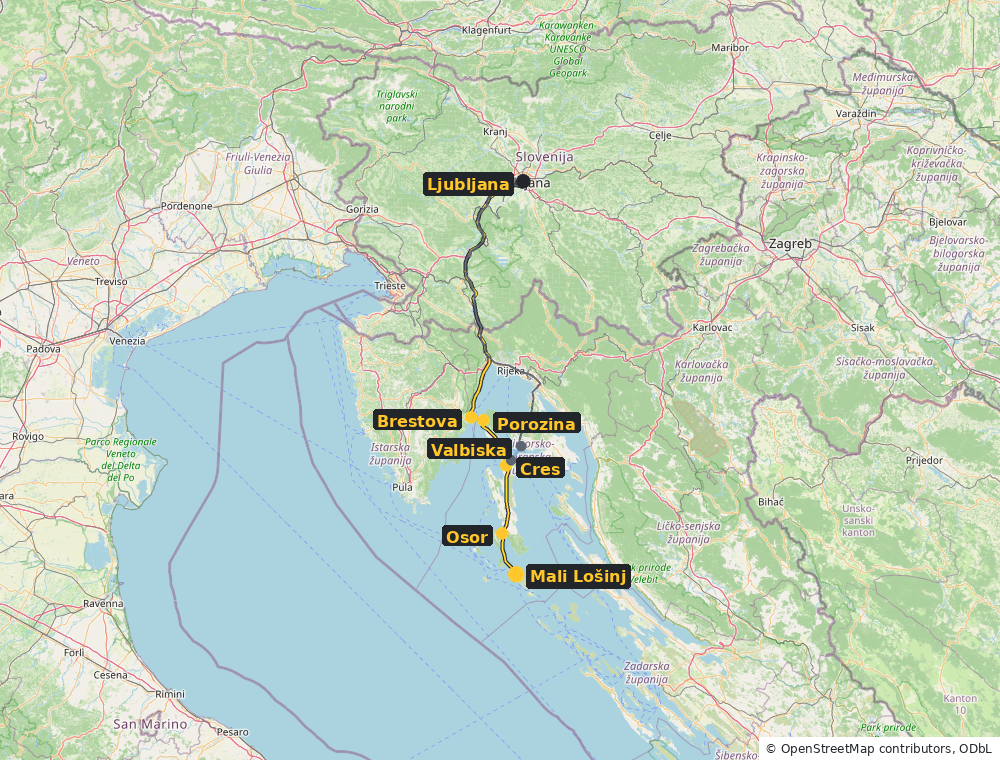
Cres and Lošinj look like two islands on the map. On the ground they are a single, long spine of road, joined by a short swing bridge at Osor, and the only serious decision is how you get the car onto Cres. From Ljubljana you have two good options: a ferry from Brestova, on the eastern shore of Istria, to Porozina; or a drive onto Krk, then the ferry from Valbiska to Merag. Both crossings are short, frequent Jadrolinija services, and both put you on an island road that runs all the way south to Mali Lošinj.
At a glance
Ljubljana to Brestova: about 139 km, typically around 2 hours 25 minutes
Ljubljana to Valbiska, via the Krk bridge: about 164 km, typically around 2 hours 35 minutes
Official tourist-board figure, Ljubljana–Mali Lošinj: 225 km
Ferries: Brestova–Porozina (line 334) and Valbiska–Merag (line 332); check times and fares on jadrolinija.hr
Osor swing bridge opens daily at 09:00 and 17:00; 20-tonne limit
There is no bridge from the mainland directly to Cres. You need a ferry, and you need to pick a harbour.
Brestova to Porozina is the more direct run if Cres and Lošinj are the point of the trip. Drive from Ljubljana towards the Kvarner coast, pay the usual Slovenian vignette and the Croatian toll at Rupa if you go that way, then follow the road past Rijeka and Opatija to the ferry terminal at Brestova. The official Mali Lošinj tourist board still presents this as one of the two standard routes from Ljubljana: Rupa, Rijeka, Opatija, Brestova, Porozina.
Valbiska to Merag is the better choice if you already want a day on Krk. Cross the Krk bridge (toll-free since 15 June 2020), drive about 29 km to Valbiska, and board there for Merag. Cres town is then a short drive; Lošinj is further south, via Osor. Both lines are year-round state ferry routes. Jadrolinija’s published 2026 timetables give 20 minutes for Brestova–Porozina (line 334) and 25 minutes for Valbiska–Merag (line 332). In 2026 the published high season is 3 July to 20 September on Brestova–Porozina and 3 July to 30 September on Valbiska–Merag. Frequencies rise in summer and thin out in winter, and a few early or late departures do not run on certain Sundays and holidays. Check the day’s sailings on jadrolinija.hr before you leave, and again the morning you travel.
Tolls and vignette
Slovenia. Buy an e-vignette before you join the A1, at evinjeta.dars.si. For a typical passenger car (class 2A) the official prices on 24 November 2026 were €16 weekly, €32 monthly and €117.50 annually. The weekly vignette covers seven consecutive days from the start date you choose.
Croatia. There is no vignette. If you go via Rupa, the official HAC Category I tariff was €1.10 on 24 November 2026. After that, the Rijeka bypass towards Opatija or the Krk bridge is not a second motorway charge, and the bridge itself is free. If you approach Brestova through the Učka tunnel after an Istria road trip, you pay Bina Istra — officially €8.70 for a Category I car from the tunnel to Kanfanar, on the operator’s calculator the same day. Confirm current amounts on hac.hr and bina-istra.com. Until at least early 2027 the plazas still use tickets or ENC; a free-flow system is due to apply fully from 1 March 2027. Croatia has been in Schengen since 1 January 2023. Slovenia lifted temporary internal controls on this border at midnight on 11 June 2026. Carry a passport or EU identity card in case of a random check. Croatia has used the euro since 2023, including on the ferries.
Ferry
Do not invent a fare from memory. Jadrolinija’s prices are official, seasonal, and tied to the size of the vehicle — length and height both matter. Look up the current tariff for your exact car on jadrolinija.hr, and keep a card ready at the kiosk. On both Brestova–Porozina and Valbiska–Merag you cannot reserve a specific sailing: Jadrolinija’s official FAQ lists these among the lines that issue tickets without a reserved departure. A ticket is valid for any crossing on the date printed on it (and on earlier dates), and vehicles board in the order they reach the port. A place on the sailing you hope to catch is not guaranteed. Jadrolinija advises arriving one to two hours ahead, and earlier in the tourist season; in July and August, allow a comfortable margin, particularly on Saturday mornings and at the end of a summer Sunday. The crossing itself is short and simple. In a strong bora, sailings can be delayed or cancelled, so check Jadrolinija and hak.hr before you commit to a tight connection.
Where to park
Parking is organised by Lošinj usluge. The main closed car park in town is the Bočac garage. On the operator’s published 2025 tariff, still presented on their site when checked on 24 November 2026, the summer rate (1 June–30 September) was €2 per hour or €16 for a daily ticket, with the garage open 07:00–23:00, including Sundays and holidays; out of season it was €1 per hour or €8 a day, 08:00–21:00, closed on Sundays and holidays. Open parking is divided into zones. Treat those figures as a guide and confirm the current list at losinj-usluge.hr. Leave the car in the garage or a signed zone and walk the Riva.
In Cres town, park at the edge of the centre and walk. In Osor, park in a signed space and leave the bridge approach clear. Lubenice has limited parking at the top.
What to see
Cres, from north to south
Cres is long, thinly populated in the middle, and greener than first-time visitors often expect. From Porozina, Cres town is about 17 km, typically around 25 minutes; from Merag it is about 14 km. The town is the natural first stop: a sheltered harbour, a compact old core, and enough life to buy food and fuel. Park at the edge of the centre and walk. If you have time, Valun is a small bay west of town, good for a swim; Lubenice, higher up, is a stone village with a view, but parking at the top is limited. Around Beli the island is known for its griffon vultures; treat that as a nature visit with local rules. South of Cres town the road runs towards Osor, about 34 km and a little over half an hour. Fill the tank when you can, and keep an eye on the time if you need to be at the Osor bridge before it opens.
The Osor bridge
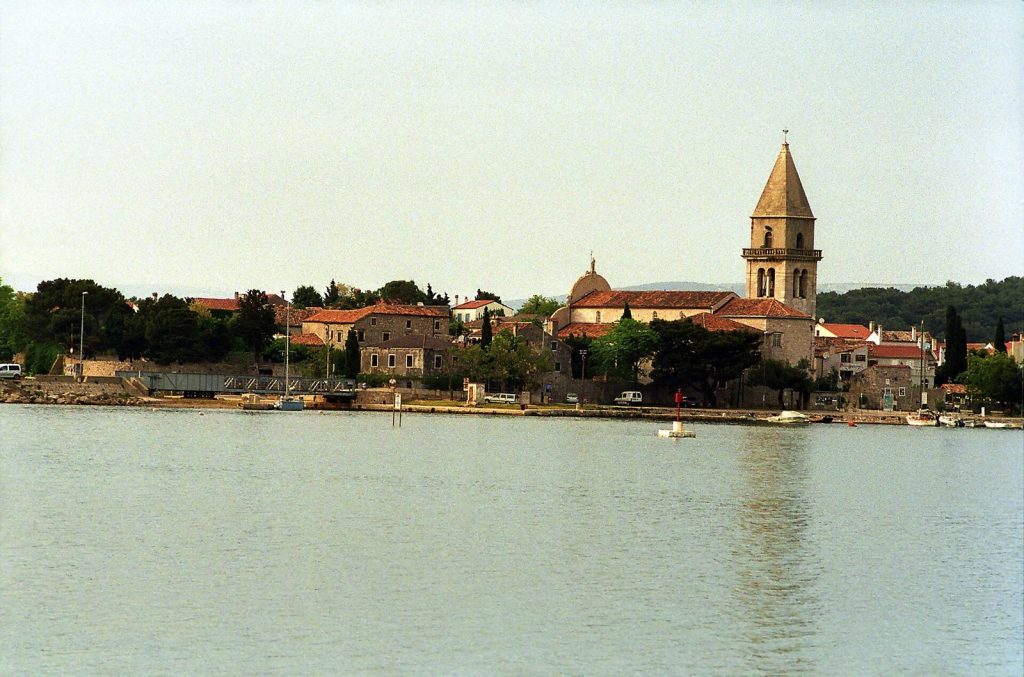
The swing bridge at Osor, between Cres and Lošinj. Photo: Falk2 / Wikimedia Commons, CC BY-SA 4.0
Osor is the hinge between the two islands: a small historic town on a narrow channel, with a movable bridge that carries all the road traffic to Lošinj. The County Port Authority of Mali Lošinj states that the Osor swing bridge opens every day at 09:00 and 17:00, turning to the east, and that the weight limit is 20 tonnes. While it is open, road traffic waits. Vessels coming from the south have priority, and only one vessel should be in the channel at a time.
Plan around those two openings, especially if you are trying to catch a ferry later in the day. A twenty-minute delay at Osor is normal; arriving at 16:55 and hoping to slip across is how people miss a sailing. There is a second movable bridge at Privlaka, further south, which the port authority lists as opening at 09:00 and 18:00, also with a 20-tonne limit. The official tourist board repeats the same times for both bridges. Osor itself is worth half an hour on foot: park in a signed space and leave the bridge approach clear.
Mali Lošinj and Veli Lošinj
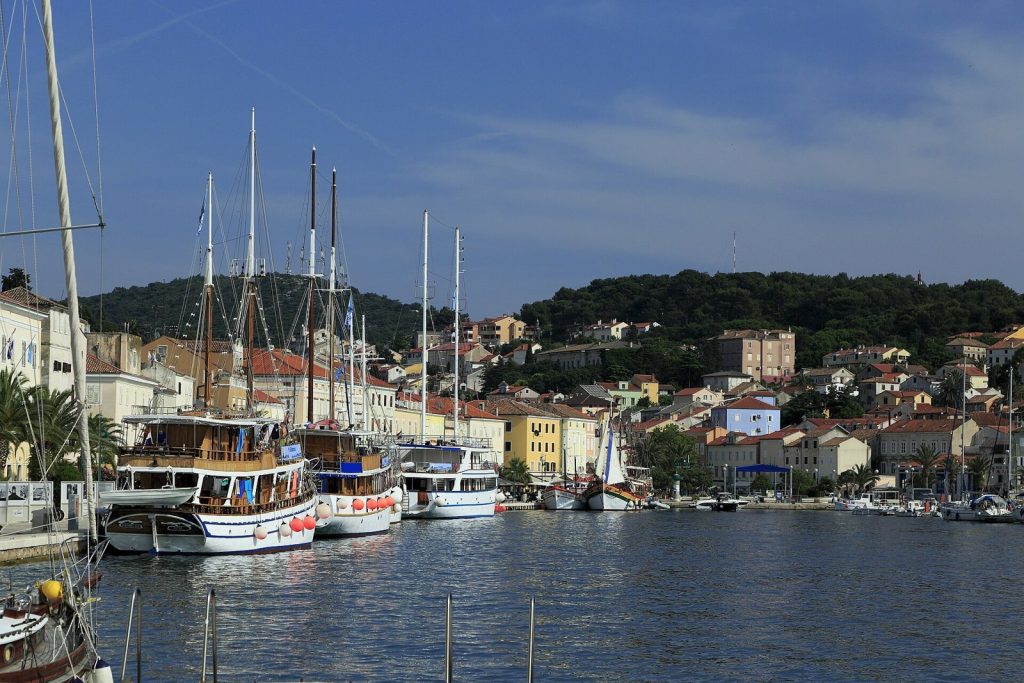
From Osor to Mali Lošinj is about 23 km, typically under half an hour. Nerezine comes first, then Mali Lošinj, the main settlement, built around a deep harbour. The waterfront promenade and the bay of Čikat, with its pines and swimming spots, are the reasons most people come. Veli Lošinj, a few kilometres further on, is smaller and a little more old-fashioned.
Suggested day plan
If your only goal is Lošinj, Brestova–Porozina is usually the cleaner line. The official tourist-board distance from Ljubljana to Mali Lošinj is 225 km: about two and a half hours to Brestova, a ferry crossing and any queue, then about an hour and a quarter of island driving, plus the Osor opening if you hit one. If you want Krk as well, use Valbiska–Merag: from Merag to Mali Lošinj is about 69 km, typically a little under an hour and a half of driving.
Via Brestova–Porozina (line 334, about 20 minutes): about 139 km and typically around 2 hours 25 minutes to the harbour, then the crossing and any queue, then about an hour and a quarter of island driving to Mali Lošinj, plus the Osor opening if you hit one.
Via Valbiska–Merag (line 332, about 25 minutes), if you want a day on Krk first: about 164 km and typically around 2 hours 35 minutes to Valbiska. From Merag to Mali Lošinj is about 69 km, typically a little under an hour and a half of driving.
On Cres, Cres town is the natural first stop (about 17 km from Porozina, about 14 km from Merag). Osor is about 34 km south of Cres town; Mali Lošinj is about 23 km beyond the bridge.
Plan around the Osor swing bridge, which opens daily at 09:00 and 17:00. A twenty-minute delay there is normal.
Practical tips
Coming home, remember that Sunday queues can be longer, and that your e-vignette must still be valid for the motorway back to Ljubljana. If one harbour is disrupted by wind, the other line is sometimes still running, at the cost of a longer drive.
In a strong bora, sailings can be delayed or cancelled, so check Jadrolinija and hak.hr before you commit to a tight connection. Fill the tank when you can.
If your only goal is Lošinj, Brestova–Porozina is usually the cleaner line. If you want Krk as well, use Valbiska–Merag. Both lines are year-round state ferry routes. In 2026 the published high season is 3 July to 20 September on Brestova–Porozina and 3 July to 30 September on Valbiska–Merag.
Can I reserve a sailing?
On both Brestova–Porozina and Valbiska–Merag you cannot reserve a specific sailing: Jadrolinija’s official FAQ lists these among the lines that issue tickets without a reserved departure. A ticket is valid for any crossing on the date printed on it (and on earlier dates), and vehicles board in the order they reach the port. Jadrolinija advises arriving one to two hours ahead, and earlier in the tourist season.
What are the times at the Osor bridge?
The County Port Authority of Mali Lošinj states that the Osor swing bridge opens every day at 09:00 and 17:00, and that the weight limit is 20 tonnes. While it is open, road traffic waits. There is a second movable bridge at Privlaka, listed as opening at 09:00 and 18:00, also with a 20-tonne limit.
Where do I park in Mali Lošinj?
Parking is organised by Lošinj usluge. The main closed car park is the Bočac garage. On the operator’s published 2025 tariff, still presented on their site when checked on 24 November 2026, the summer rate was €2 per hour or €16 for a daily ticket. Treat those figures as a guide and confirm the current list at losinj-usluge.hr.